You heard someone call their friend a “torta” and now you are sitting there wondering if it was a compliment or a food order. You are not alone. This word has quietly slipped from kitchen tables into everyday conversations, social media captions, and group chats. So what does torta actually mean in slang? In short, it is a term of endearment used mostly in Latin American Spanish-speaking communities to call someone chubby, pudgy, or lovably round, but context shapes everything.
What Does Torta Mean in Slang, Exactly?
At its core, torta in slang means a chubby or heavyset person, usually said with warmth and affection rather than cruelty. Think of it as the Spanish-speaking world’s version of calling someone a “teddy bear” or a “big softie.”
The word originally refers to a round, flat cake or a Mexican sandwich, depending on which country you are in. But language has a funny habit of borrowing food words to describe people, and torta made the jump from the kitchen to casual conversation a long time ago.
In everyday slang, people use it to lovingly tease a friend, a sibling, or even a romantic partner. It rarely lands as an insult when used between close friends because the tone carries as much meaning as the word itself.
Where Did This Slang Come From? The Origin Story
To understand how torta became slang, you need to understand what a torta actually is. In Spanish, torta literally means “cake” or “bread loaf.” In Mexico, it refers to a specific type of hearty sandwich stuffed generously with fillings, basically a round bread roll packed to its limit.
That visual matters. A torta is round, full, a little overloaded, and undeniably satisfying. At some point, someone made the connection between that stuffed, rounded bread and a person with a similar build, and the nickname stuck.
This kind of word evolution is actually ancient. Cultures across history have used food to describe body types. The Romans described wealthy, well-fed citizens with food metaphors. Medieval European societies linked a round figure to health, prosperity, and abundance rather than anything negative.
In Latin America, calling someone a torta carries that same layered meaning. It started as a purely physical description but softened over time into something that sounds more like “you adorable, squishy human” than anything harsh.
How Torta Is Used in Different Countries
Here is where things get interesting, because torta does not mean exactly the same thing everywhere.
| Country / Region | Primary Meaning of Torta | Slang Usage |
| Mexico | A type of sandwich | Chubby, heavyset person (affectionate) |
| Spain | Slap or punch | Clumsy or awkward person |
| Argentina | Cake or dessert | Rarely used as slang for people |
| Colombia | Cake or mess (un error) | A blunder or mistake |
| Venezuela | Flat bread or cake | Occasionally used to mean chubby |
| General Latin America | Round food item | Pudgy person, usually said with love |
Notice that in Spain, torta can mean a slap, which makes the slang usage there feel very different. Context and geography do all the heavy lifting with this word.
Heard “Skibidi” in chats and unsure what it means? Check out Skibidi Slang Meaning
Torta in Modern Slang and Social Media
On platforms like TikTok, Instagram, and Twitter, torta shows up most often in two ways. First, someone posts a cute video of a chubby baby, a roly-poly pet, or a heavyset friend being adorably clumsy, and the comments flood in with “qué torta tan linda” which loosely translates to “what an adorable little chubby one.”
Second, people use it as a self-identifier with humor and confidence. Someone might caption their own photo with “soy una torta pero soy feliz” meaning “I am a torta but I am happy.” That kind of self-aware humor has made the word feel much more empowering than insulting in online spaces.
This shift matters. A word that once might have stung now gets reclaimed with humor and worn like a badge of personality. That is the power of tone and community.
The Affectionate Side: When Torta Is Actually Sweet
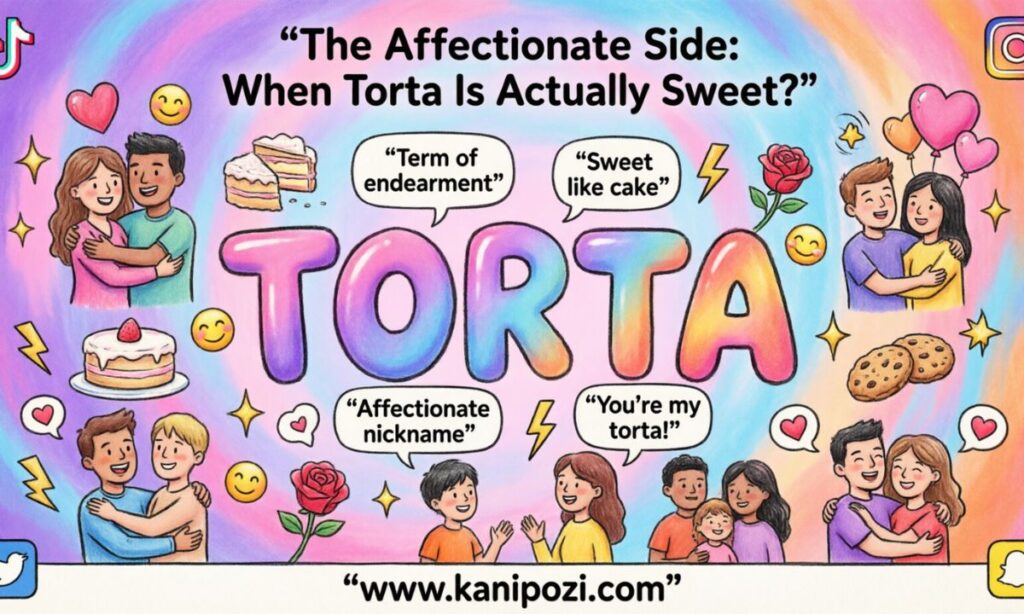
In close relationships, being called a torta is almost always a good thing. Parents call their chubby toddlers tortita (little torta) with the same warmth that English-speaking grandmothers pinch cheeks and say “you look healthy.” It is a term soaked in love.
Between romantic partners, especially in Mexico and Central America, mi torta can be a playful nickname that mixes physical affection with humor. It says “I see you, I find you adorable, and I am not afraid to say it out loud.”
The suffix matters a lot here. Torta stays neutral or playful. Tortita or tortitita adds layers of softness and affection, the way adding “little” to almost any nickname in English makes it instantly warmer.
When Torta Crosses the Line: The Difference Between Teasing and Insulting
Here is the part that trips people up. Torta is not always sweet, and calling someone that without the right relationship or tone can land badly.
The difference usually comes down to three things:
Relationship closeness: Between best friends or family, it is almost always playful. Between strangers or acquaintances, it can feel like a comment on someone’s body without their permission.
Tone of voice or written context: Said with laughter and warmth, it reads as affection. Said with a cold tone or paired with other unkind words, it reads as mockery.
The person’s own feelings about it: Some people embrace the label happily. Others find it uncomfortable regardless of intent. When in doubt, do not use it unless the other person has already used it about themselves.
Related Slang Words You Might Also Hear
If you are navigating Spanish slang around body types and affectionate teasing, a few related words often travel alongside torta.
Gordito or gordita is probably the most common one, meaning “chubby” or “little fat one,” and like torta, it is frequently used as a loving nickname rather than an insult between close people.
Relleno or rellena literally means “stuffed” or “filled,” like a stuffed pepper, and gets used similarly to torta in some regions.
Bombón means “bonbon” or “chocolate” and is actually a compliment about attractiveness, not body size, though it occasionally overlaps in usage.
Pastelito which means “little pastry,” follows the same food-to-person metaphor logic as torta but tends to skew even more affectionate and less about physical build.
Common Mistakes People Make with This Word
Mistake one: Assuming it always means the same thing. Because torta means a sandwich in Mexico and a cake in Spain, the slang usage and its reception differ widely. Do not assume the meaning transfers cleanly across borders.
Mistake two: Using it with someone you do not know well. Even in slang-friendly cultures, commenting on someone’s body shape with a food nickname without knowing them is a social risk not worth taking.
Mistake three: Confusing it with the culinary torta. If someone from Mexico asks if you want a torta, they are offering you a sandwich, not calling you chubby. Read the situation before getting offended or confused.
Mistake four: Thinking the tone does not matter. Two people can say the exact same word and mean completely different things based on delivery. Torta is one of those words where tone does about 80 percent of the work.
Should You Use Torta as Slang?
Honestly, that depends on who you are talking to and what your relationship with them looks like.
If you are a native or fluent Spanish speaker in a close social circle where this kind of affectionate teasing is normal, then yes, torta fits naturally into that kind of banter.
If you are learning Spanish and you heard it in a show or song and want to try it out, hold off until you are confident about the context. Body-related nicknames have a short runway before they become awkward, and this one is no exception.
If the person you are talking to has used it about themselves with humor, mirroring that language back is usually fine and can actually be a bonding moment.
When in doubt, stick to gordito if you must use affectionate body-related slang, since it is more universally understood and has a longer cultural history of being used warmly.
Quick Summary: Torta Meaning Slang at a Glance
What it means: A chubby, heavyset, or lovably round person.
Where it comes from: The word for a round food item (cake or sandwich) applied to people with a similar shape.
Who uses it: Mostly Spanish speakers in Latin America, especially Mexico.
When it is okay: Between close friends, family, or romantic partners who share this kind of humor.
When it is not okay: With strangers, in formal settings, or without understanding the other person’s comfort level.
Tone matters most: Said with warmth, it is a term of endearment. Said coldly, it becomes something else entirely.
Frequently Asked Questions
Is torta an offensive slang word?
Not inherently. Whether it offends depends almost entirely on the relationship between the people involved and the tone used. Between close friends or family, it almost always reads as playful. Between strangers, it risks coming across as a body comment without consent. The word itself is neutral; the situation gives it meaning.
Does torta mean the same thing as gordita?
They are similar but not identical. Gordita directly means “little chubby one” and is used across nearly all Spanish-speaking regions. Torta uses a food metaphor and is more concentrated in Mexican and Central American slang. Both get used affectionately in the right context, but gordita has a wider geographic reach.
Why do Spanish speakers use food words to describe people?
Food is central to culture, family, and affection in many Latin American communities. Using food words to describe people carries warmth because food itself is associated with love, nurturing, and care. Calling someone a torta or a bombón is a way of saying they are something good, something worth savoring. Language always reflects what a culture values, and in many Latin cultures, feeding someone and caring for someone are nearly the same act.
Final Thought: A Small Word With a Lot of Heart
Torta in slang is one of those words that sounds simple on the surface but carries a whole layer of cultural warmth underneath. It started as food, turned into a nickname, and landed somewhere between a teasing observation and a genuine term of affection. Use it right and it brings people closer. Use it carelessly and it does the opposite. Now that you know the difference, you are ready to navigate the conversation with a little more confidence and a lot less confusion.