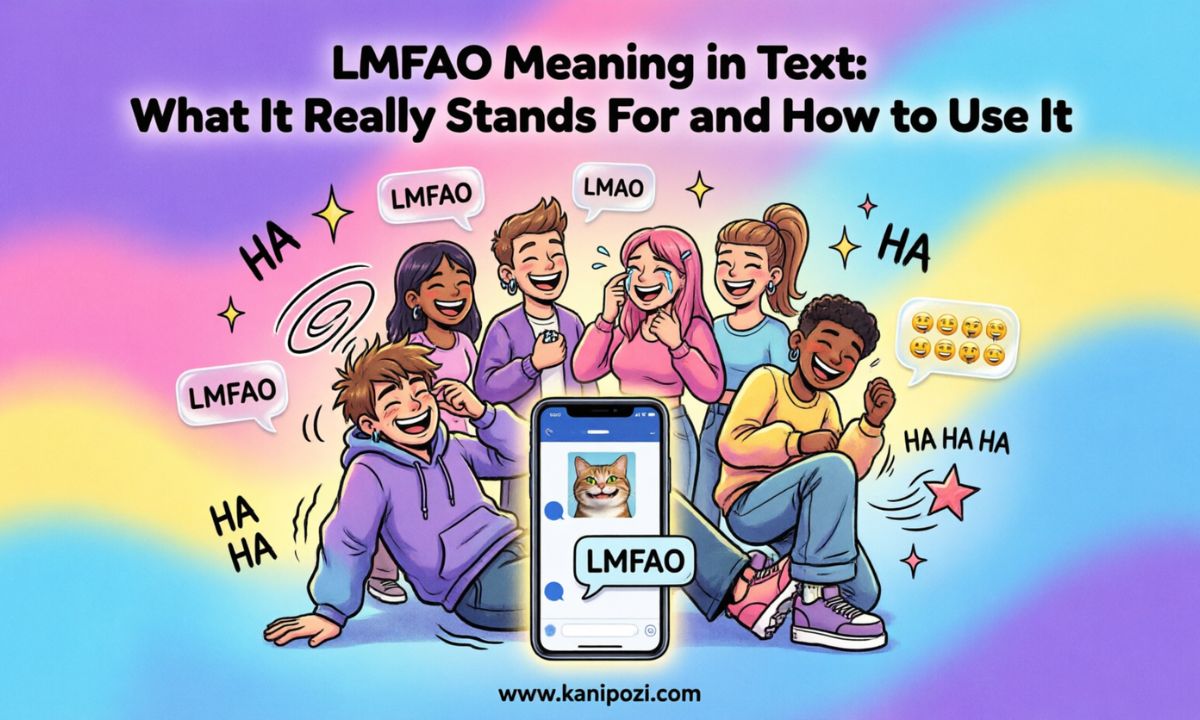
You just received a text ending in “LMFAO” and now you are staring at your screen wondering what just happened. Do not worry. LMFAO stands for “Laughing My F*ing A** Off.”** People use it in texts, chats, and social media to express extreme laughter. Think of it as the turbocharged, uncensored version of LOL. If LOL is a polite chuckle, LMFAO is falling off your chair with tears running down your face. It is casual, expressive, and definitely not for your work emails.
What Does LMFAO Mean in Text?
Let us break it down letter by letter so there is zero confusion left.
L stands for Laughing M stands for My F stands for F*ing** (the intensifier) A stands for A** (the body part referenced) O stands for Off
Put it all together and the full meaning reads: someone is laughing so hard they feel like a body part is literally flying off their body. Obviously, nobody is actually losing anything. It is just the internet being dramatic in the most entertaining way possible.
LMFAO usually appears at the end of a sentence or completely alone as a reply. Both uses are perfectly correct and widely understood.
LMFAO vs LMAO vs LOL: What Is the Actual Difference?
These three abbreviations all signal that something is funny, but they carry very different levels of intensity. Mixing them up can make your reaction feel off.
| Abbreviation | Full Form | Intensity | Best Used When |
| LOL | Laugh Out Loud | Mild | Something is mildly funny or you want to sound friendly |
| LMAO | Laughing My A** Off | Medium | Something genuinely made you laugh |
| LMFAO | Laughing My F*ing A Off | Maximum | Something is absolutely, outrageously hilarious |
Think of it as a volume dial. LOL is volume 3. LMAO is volume 7. LMFAO is volume 11 with the speakers threatening to blow out.
The only real difference between LMAO and LMFAO is that one extra F-word. That single addition turns the expression from casual amusement into full-on, uncontrollable laughter. It is a small change that carries a big emotional punch.
Where Did LMFAO Come From?
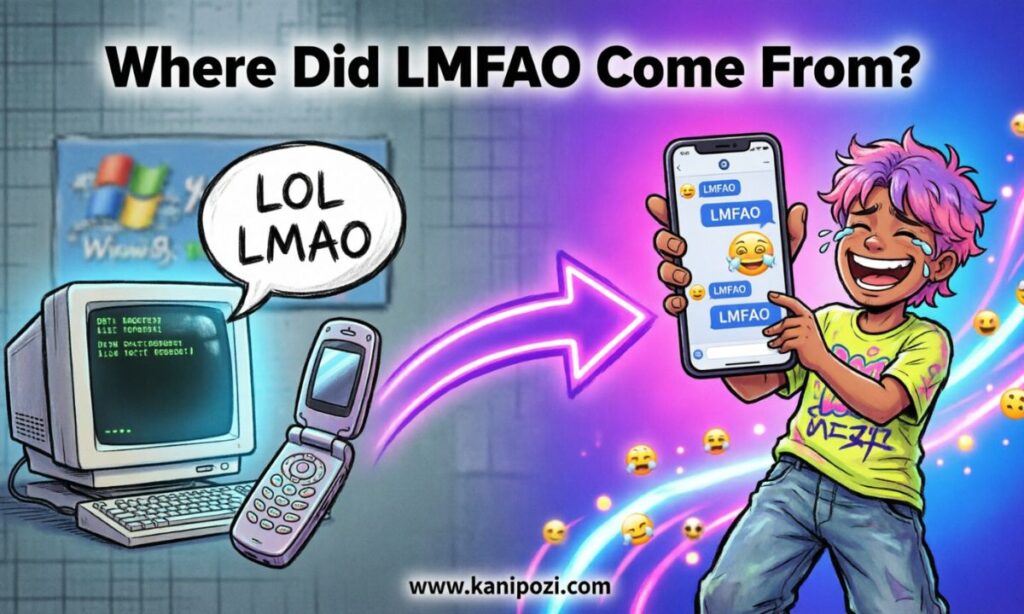
LMFAO grew out of internet culture in the early 2000s, right alongside the rise of AOL Instant Messenger and early chat forums. As people started communicating faster online, abbreviations like LOL, BRB, and LMAO became part of everyday digital conversation.
LMFAO was a natural next step. When LMAO did not feel strong enough, people added the intensifying F-word to push the emotion further. It followed a pattern already common in spoken language, where adding that word to any expression makes it significantly stronger.
In 2006, a music duo actually adopted LMFAO as their group name, which pushed the abbreviation into mainstream pop culture. Their songs reached global charts and introduced the phrase to millions who had never seen it in a text before. That said, the slang existed long before the music group and continues to thrive long after.
Even ancient writers used exaggerated expressions to describe laughter. While they did not have acronyms, the human need to signal “this is outrageously funny” is as old as storytelling itself. LMFAO is just the 21st-century version of that timeless impulse.
Real-Life Examples of LMFAO in Text Conversations
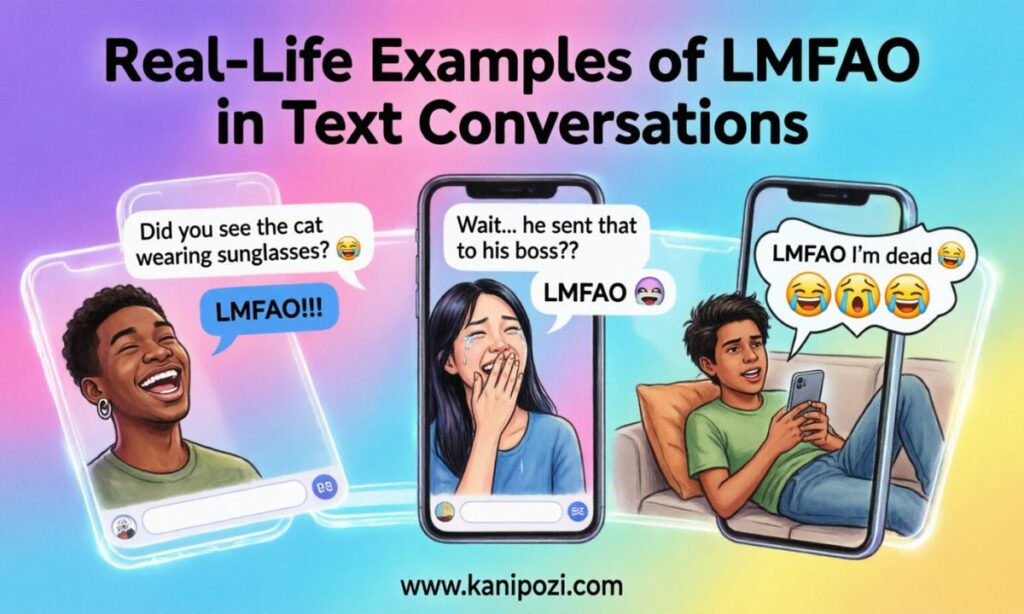
Reading about it is one thing. Seeing it used naturally makes everything click much faster.
Example 1: Text Message Between Friends Friend: “My cat walked directly into the glass door and then looked at me like it was my fault.” You: “LMFAO that cat has zero self-awareness”
Example 2: Group Chat Friend: “I just called my teacher Mom in front of the entire class.” You: “LMFAO I did that in 7th grade and never recovered”
Example 3: Social Media Comment Someone posts a video of a dog trying to drag an entire tree branch through a narrow doorway. Comment: “LMFAO he is NOT giving up on that branch”
Notice that in every example, LMFAO appears in response to something genuinely surprising or absurd. It is not a filler word. It carries real emotional weight, which is exactly why overusing it weakens the effect over time.
When Is It Appropriate to Use LMFAO?
LMFAO works best in casual, personal communication. If you are texting a close friend, chatting in a gaming group, or dropping a comment under a funny meme, you are in completely safe territory.
Here is where it fits naturally:
- Text messages with close friends or family
- Private social media messages with people you know well
- Public comments on comedy content or meme pages
- Gaming chats and hobby group conversations
- Casual online communities where informal tone is the norm
The guiding principle is simple. If the conversation is relaxed and personal, LMFAO fits right in. If the conversation involves a boss, a client, a professor, or any formal setting, it does not belong anywhere near your message.
Quick gut check: Before you type LMFAO, ask yourself: “Would I say this word out loud in front of this person?” If the answer is no, stick with “haha” or a laughing emoji instead.
When You Should Absolutely Not Use LMFAO
This might seem obvious, but habit and autocorrect have led people into genuinely awkward situations. LMFAO contains an expletive, which means it carries the same social risk as using that word out loud in a room.
Situations where LMFAO will cause real problems:
- Work emails or Slack messages to colleagues you do not know well
- Messages to a professor, teacher, or academic institution
- Customer service conversations of any kind
- Messages to someone older who may find the language disrespectful
- Official or legal communication
- Texts to someone you just met and have no established tone with
The unwritten rule of internet slang is this: match the energy and formality of the person you are talking to. If their messages are proper and punctuated, yours probably should be too.
Common Mistakes People Make With LMFAO
Using LMFAO incorrectly is not a crisis, but it can make your message land flat or feel forced. Here are the most frequent errors worth avoiding.
Using it when nothing is actually that funny. LMFAO implies extreme laughter. If you type it after a mildly amusing comment, it reads as exaggerated or sarcastic in the wrong way. Save it for moments that genuinely earn it.
Overusing it in every message. When LMFAO appears five times in one conversation, it loses all its punch. It starts feeling like a verbal habit rather than a genuine reaction. Use it sparingly so it stays meaningful when it does appear.
Sending it in the wrong context. Context matters enormously. LMFAO sent to your grandmother after she shares a cat photo might confuse or even offend her. Always know your audience before you send.
Confusing it with LMAO. They are close but not identical. LMFAO signals a stronger reaction. Using it for something only mildly funny can come across as performative, like laughing too loudly at a mediocre joke.
How LMFAO Appears Differently Across Platforms
The abbreviation stays the same everywhere, but how it is used shifts depending on where you are online.
On Twitter and X, LMFAO often appears in quote tweets where someone reshares something absurd and adds it as their only commentary. It functions almost like a stamp of approval for comedy content.
On Reddit, you will see it in comment threads, often written in lowercase (lmfao) for a more laid-back tone. Lowercase signals the same meaning but feels slightly less intense, which suits the longer discussion format of that platform.
On Instagram and TikTok, LMFAO fills comment sections under funny videos, usually paired with a crying-laughing emoji for extra emphasis.
In gaming communities and Discord servers, it appears constantly and rapidly, sometimes as the only response needed when something ridiculous happens mid-game.
The same abbreviation can feel casual or emphatic depending entirely on tone, context, and platform culture. That is what makes internet language so fascinating to watch evolve.
Which One Should You Use: LOL, LMAO, or LMFAO?
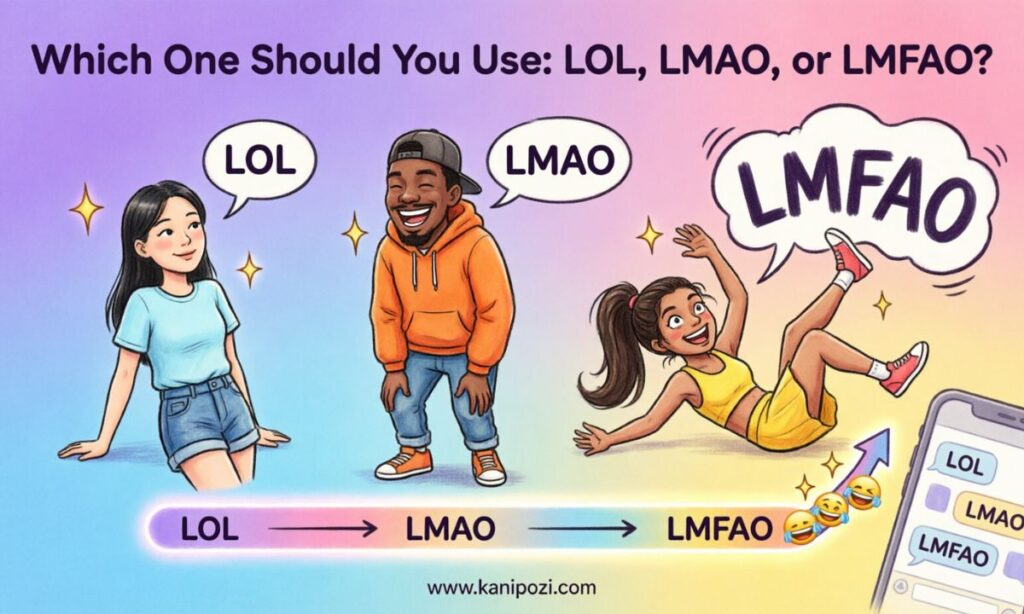
This comes down to one honest question: how funny is it, really?
Use LOL when something made you smile, when you want to soften a message, or when you are being friendly without necessarily finding something hilarious. LOL has also evolved into a tone softener in modern texting, not just a laughter signal.
Use LMAO when you genuinely laughed. It is direct, expressive, and appropriate for most casual conversations. It is the comfortable middle ground that works almost everywhere informal language is welcome.
Use LMFAO when something was so funny that a normal response feels completely inadequate. Reserve it for moments that actually made you react out loud, something that surprised you, made you snort, or made you immediately want to share it with someone else.
If you are ever unsure which to use, LMAO is your safest choice. It carries genuine humor without the expletive, giving it a wider social reach without losing the authenticity.
Does Capitalization Matter: LMFAO vs lmfao?
Technically, the meaning does not change at all. Both LMFAO and lmfao communicate exactly the same thing. But in practice, capitalization carries subtle social signals in text conversations.
ALL CAPS LMFAO reads as louder, more emphatic, and occasionally more sarcastic depending on context. It can feel like the written equivalent of shouting the phrase across a room.
Lowercase lmfao reads as more relaxed, genuine, and casual. Many people feel that lowercase reactions seem more natural and less performative, especially in longer conversations.
There is no rule here. Both versions work perfectly. Let your personal texting style and the mood of the moment guide you.
Related Slang Worth Knowing
Once you understand LMFAO, a few related terms complete your internet language toolkit.
ROFL (Rolling On the Floor Laughing): Another intense laughter abbreviation with similar energy to LMFAO but without the expletive. Works well when you want to be expressive but keep the language clean.
ROFLMAO: A combination of ROFL and LMAO used when one acronym simply does not feel like enough to capture how funny something was.
The skull emoji 💀: The modern replacement for LMFAO among younger users. Saying “I’m dead” or dropping a skull emoji now signals the same level of extreme laughter, often feeling even more current than the abbreviation itself.
Dead: As in “I’m dead” or simply “dead.” Another way of saying something was so funny it metaphorically ended you. Falls in the same emotional category as LMFAO and is widely understood by anyone under 35.
Crying laughing emoji 😂: Often paired with or used instead of LMFAO, especially by people who prefer expressive emojis over text abbreviations.
LMFAO has been part of online communication for over two decades, which in internet years makes it practically a classic. Knowing its newer alternatives helps you understand the full picture of how people express laughter in the digital age.
Frequently Asked Questions About LMFAO
Is LMFAO considered a swear word?
LMFAO contains a strong expletive in its full form, so yes, it carries the same social weight as using that word out loud. In casual texts between close friends, most people do not consider it offensive. In any professional or formal setting, it is best avoided entirely. A simple rule: treat it the same way you would treat saying that word aloud in a given situation.
Can LMFAO be used sarcastically?
Yes, absolutely. Like most expressive slang, LMFAO can signal that something is so ridiculous it is almost funny rather than actually funny. Context and tone carry everything in text conversations, so the way it lands depends heavily on what surrounds it. When used sarcastically, the rest of the message usually makes the tone unmistakably clear.
Is LMFAO still used in 2025?
Yes, LMFAO is still very much in active use. Older internet slang tends to stick around because it is clear, expressive, and understood across age groups. Younger users have added alternatives like the skull emoji and “I’m dead,” but LMFAO remains widely understood and commonly used, particularly in text messages and comment sections across all major platforms.
The Bottom Line on LMFAO
LMFAO is one of the most expressive laughter abbreviations in digital communication. It means “Laughing My F*ing A Off,” it signals extreme amusement, and it has been a fixture of online conversation since the early days of the internet.
Use it freely with close friends when something genuinely cracks you up. Keep it out of professional conversations. And whenever you reach for it, make sure the moment actually earned it. When it does, go right ahead and send it without a second thought.