Quick Answer
XD is a text-based emoticon that means intense laughter or extreme amusement. Tilt your head to the left and you will see it: the “X” forms two eyes squeezed shut from laughing, and the “D” forms a wide-open mouth. Together, they draw a face that is laughing so hard it can barely keep its eyes open. People use XD the same way they use 😂 or LOL — to show something genuinely cracked them up.
You are in the middle of a funny conversation, someone drops a hilarious joke, and instead of typing a long response, they just send back XD. Simple. Iconic. But if you have never seen it before, it looks like someone accidentally pressed two random keys. That confusion ends here.
This guide covers everything: what XD means, where it came from, how to use it correctly, and the mistakes that make it awkward. By the end, you will know exactly when to type XD and when to reach for something else.
What Does XD Actually Look Like?
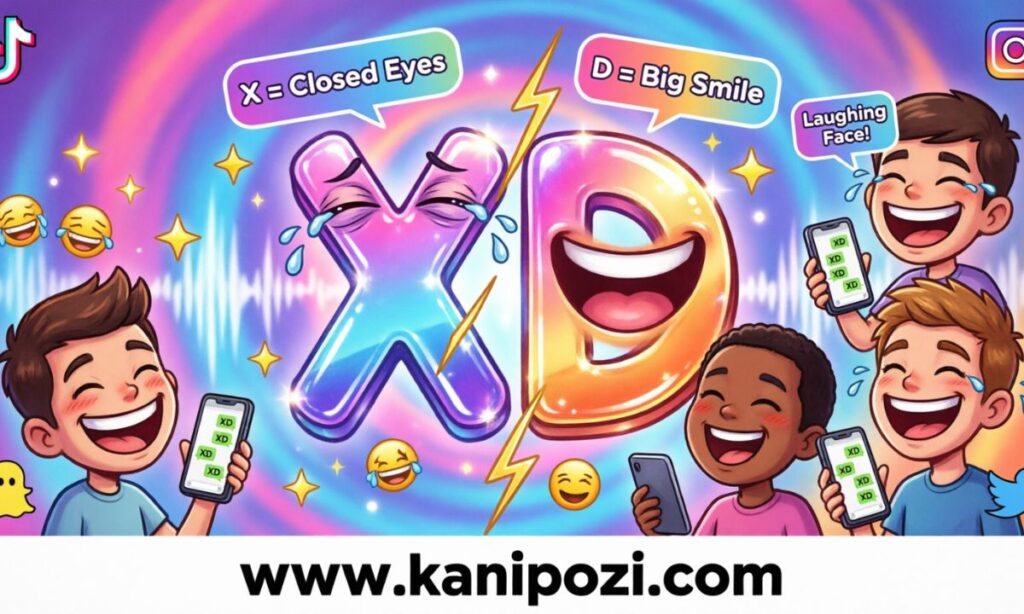
The genius of XD is that it is a picture hiding inside letters. Tilt your head 90 degrees to the left and you will see it instantly. The “X” becomes two eyes squeezed tightly shut, the way your face looks when something is genuinely hilarious. The “D” right next to it becomes a giant open mouth, mid-laugh.
Together, they form a laughing face. Not a polite smile. Not a chuckle. A full-on, eyes-clamped-shut, mouth-wide-open burst of laughter. That is the entire emotional message XD carries in just two characters.
This type of sideways text picture is called a text emoticon or kaomoji (Western style). Before smartphones handed us a library of emoji, people were building faces from keyboard characters. XD was one of the best ones because it required only two letters and communicated so much.
Where Did XD Come From? The Origin Story
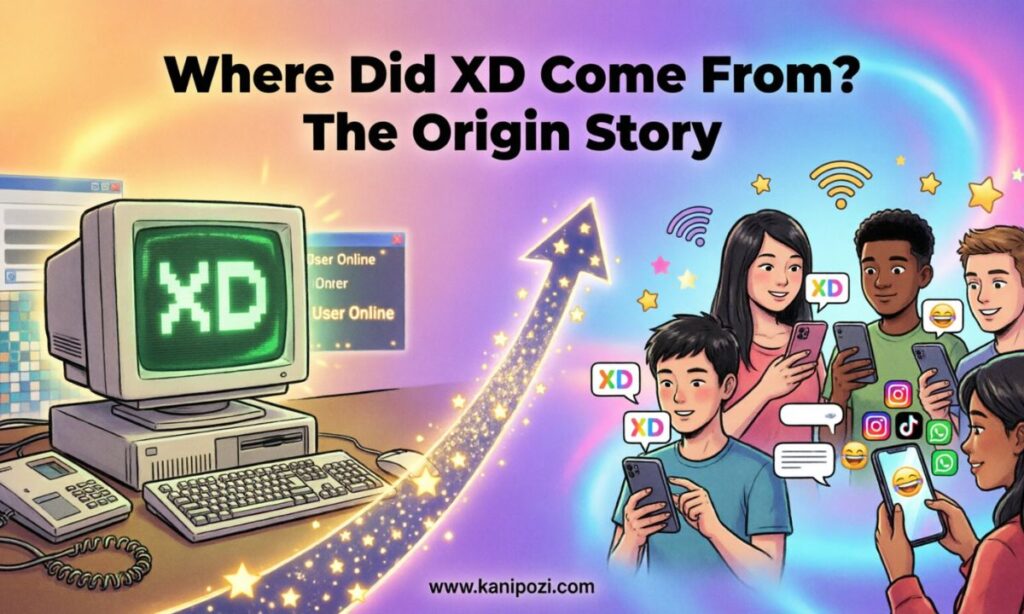
XD did not appear overnight. It grew out of a broader culture of keyboard-based expressions that started in the early days of the internet, particularly in chatrooms, IRC channels, and early instant messaging platforms like AIM and MSN Messenger during the late 1990s and early 2000s.
At that time, people were already using 🙂 for smiling and 😀 for laughing. The D shape for an open laughing mouth was already established. Adding an X before it to represent squeezed-shut eyes was a natural creative step that the online community took organically.
By the mid-2000s, XD was everywhere. Gaming forums, fan fiction communities, and early social media like MySpace all adopted it. Gaming culture in particular loved it because online game chats called for quick, expressive reactions. Typing XD was much faster than typing “haha that was hilarious.”
Interestingly, XD also carries influence from Japanese manga and anime. In Japanese comics, artists draw characters with X-shaped eyes and wide open mouths to depict extreme laughter or comical situations. Western internet culture absorbed this visual shorthand and turned it into a keyboard combination.
How XD Is Used in Real Conversations
Understanding the meaning is one thing. Seeing it in action makes it click immediately. Here are realistic examples:
Between friends:
“I just walked into a glass door in front of my entire office.” “XD I cannot breathe.”
XD here signals helpless laughter. Adding “I cannot breathe” makes the reaction even more vivid.
In gaming chat:
“I was winning the whole match and then tripped on a pebble and died.” “LMAO XD that is actually painful.”
Gaming chats love stacking XD with other expressions for maximum comedic emphasis.
Reacting to a funny story:
“My cat figured out how to open the fridge and has been stealing cheese for a week.” “XD your cat is living a better life than me honestly.”
XD at the start of a response shows the laughter came first, before the follow-up thought.
XD vs LOL vs 😂: What Is Actually Different?
People use XD, LOL, and the crying-laughing emoji somewhat interchangeably, but they carry slightly different flavors.
| Expression | What It Signals | Intensity |
|---|---|---|
| XD | Intense, eyes-shut helpless laughter | High |
| LOL | General amusement; often just acknowledgment | Low to Medium |
| LMAO | Stronger laughter; suits absurd or mocking moments | High |
| 😂 | Laughing with tears; modern and widely understood | High |
| haha | Genuine but relaxed amusement | Low to Medium |
| HAHAHA | Loud, uncontrolled laughter | Very High |
The key thing separating XD from the rest is its visual identity. When you type XD, you are not just writing letters — you are drawing a tiny laughing face. That visual dimension gives it a warmth and playfulness that pure text abbreviations like LOL cannot match.
LOL has also been overused to the point where it barely means laughter anymore. Many people type it just to soften a sentence. XD still carries weight because it pictures something specific: laughter so intense the eyes disappear.
If NRS leaves you wondering, see NRS Meaning in Text.
Does Capitalization Matter? XD vs xd vs Xd
Most guides skip this, but it actually matters.
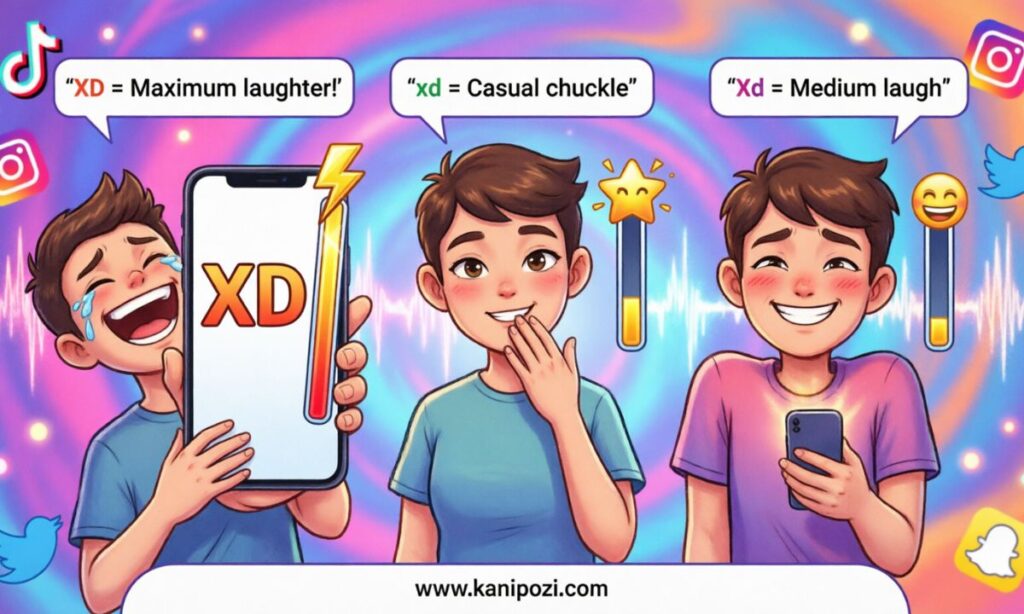
XD (all caps) is the standard, classic form. It reads as energetic and enthusiastic, exactly as the original emoticon was designed.
xd (all lowercase) has become common in younger online communities and gaming chats. It often carries a dry, deadpan, or ironic tone. When someone types “xd,” they might be laughing, or they might be reacting with exaggerated mock amusement. The lowercase version can signal that something is funny in a cringeworthy or absurd way rather than a genuinely delightful one.
Xd (mixed) happens mostly when autocorrect gets involved. It reads as a typo rather than a deliberate stylistic choice.
Practical tip: If you want to express genuine delighted laughter, go with XD. If the vibe is dry humor or absurd irony, xd fits the tone better.
Common Mistakes People Make With XD
Using XD in formal or professional messages. Sending your boss a message with XD is a fast way to look unprofessional. It belongs in casual conversations with friends, not in work emails or official contexts.
Overusing it until it loses meaning. Dropping XD after every single message waters it down. Its power comes from expressing genuine laughter. If you use it constantly, it starts to read like background noise.
Using it to soften bad news. “Sorry I forgot your birthday XD” lands badly because XD signals amusement, not regret. The emoticon and the emotional context clash in a way that makes the apology feel worse, not better.
When Should You Use XD and When Should You Not?
Use XD when:
- Chatting with close friends or family
- Reacting to genuinely hilarious moments
- In gaming chats or online communities
- On informal social media posts
Avoid XD when:
- Messaging a colleague, employer, or client
- Talking with someone you just met
- Discussing serious or sensitive topics
- You want to come across as polished or professional
If you are ever unsure, look at how the other person is communicating. If they are using emoji, abbreviations, and casual language, XD fits right in. If their messages are formal and complete, mirror that energy instead.
Is XD Still Cool to Use Today?
XD has an interesting status in 2025: it is no longer cutting-edge, but it has not disappeared either.
Among older millennials and Gen X users who grew up with early internet culture, XD still shows up naturally. In gaming communities, it remains common and feels completely at home.
Among younger Gen Z users, XD sometimes carries a retro or ironic quality. Using it can signal that you are in on the nostalgia, or that you are being intentionally playful with older internet language. The lowercase xd version has actually gained traction in these communities for exactly that dry, ironic reason.
XD is not outdated, but it does have a personality. It suits casual, warm, playful conversations better than it suits ultra-modern or hyper-cool digital spaces. Think of it like a comfortable classic outfit rather than chasing the newest trend. It works, it has charm, and everyone knows what you mean.
Related Expressions Worth Knowing
😀 is a simpler, milder laughing face. The colon is two open eyes, and the D is the same wide grin. It signals happiness and laughter without the eye-squinting intensity of XD.
O.O or 0.0 signals wide-eyed shock or disbelief. In some ways the opposite of XD: eyes wide open instead of squeezed shut.
TT or T.T represents crying eyes, used to show sadness or sympathetic distress. Common in K-pop fan communities and East Asian internet culture.
UwU expresses warmth, cuteness, or affection. It pictures a small happy squinting face and is popular in anime and gaming communities.
All of these share XD’s logic: pictures drawn with keyboard characters that communicate emotional states more vividly than any single word could.
Frequently Asked Questions
Does XD mean something different in different countries?
The core meaning is consistent across English-speaking internet culture globally. In Spanish-speaking communities, XD is understood the same way. In Japanese and Korean online spaces, similar emoticons exist but use different character combinations. The visual logic of XD translates well across cultures because the laughing face it depicts is universally recognizable.
Is XD the same as the 😆 emoji?
They are very close in meaning. The 😆 emoji is essentially the digital evolution of XD. Both depict eyes squeezed shut from laughter and a wide grin. The difference is that 😆 is a polished graphic while XD is a text emoticon you build from letters. XD feels more personal and retro; the emoji feels more modern and universally legible.
Can XD be used sarcastically?
Yes, and more often than people realize. When someone types “xd” in lowercase, it frequently carries a dry or ironic tone. In gaming and certain online communities, “xd” after a mildly annoying or absurd situation signals exasperated amusement rather than genuine delight. The surrounding context is what makes the sarcasm readable.
The Short Version
XD is one of the internet’s most enduring text emoticons. It means intense laughter, it looks like a laughing face when tilted sideways, and it has been making digital conversations warmer and funnier since the early days of online chat.
Use it freely with friends and in casual communities. Keep it out of professional settings. Pay attention to whether you type XD or xd, because that small detail carries a real difference in tone. And the next time someone sends you XD after your best story, you can fully appreciate it: they were laughing too hard to keep their eyes open. That is a good thing to give someone.