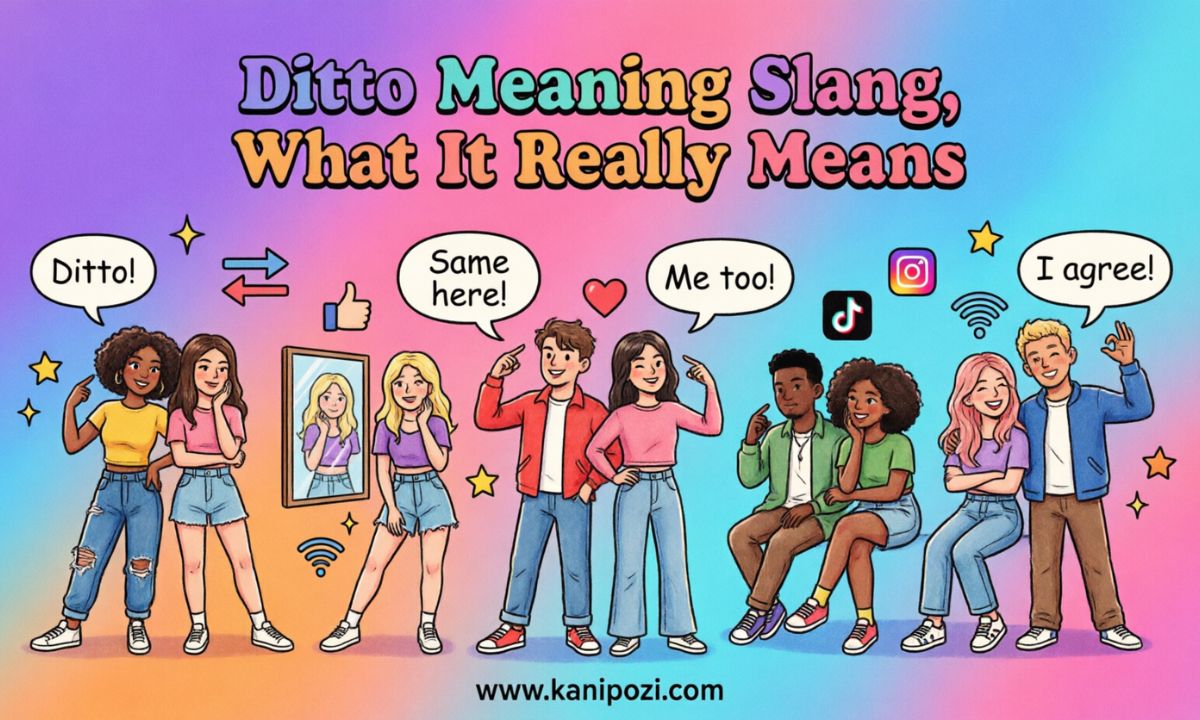
Quick Answer — Featured Snippet: In slang, ditto means “same here,” “I agree,” or “me too.” It is a short, casual way to echo someone else’s feelings or opinion without repeating their exact words. Gen Z uses it across TikTok, Discord, Instagram, and text chats to signal instant agreement, emotional solidarity, or shared vibes. It comes from the Italian word detto, meaning “said” and has been used in English since the early 1700s.
If you have ever typed — or received — a single “ditto” in a group chat and wondered whether it meant approval, sarcasm, or something deeper, you are not alone. In 2026, “ditto” pops up in TikTok comments, Discord servers, Instagram captions, K-pop fan communities, and construction spreadsheets all in the same day. That range tells you everything: this is a word that lives in multiple worlds at once.
This guide breaks down every meaning of ditto — from casual slang to romantic subtext to professional usage — so you understand exactly what someone means, no matter where they say it.
What Does Ditto Mean? Core Meaning Explained
At its most basic level, ditto means “the same” or “as previously stated.” In conversation and online chat, it functions as a shortcut for “I feel the same way,” “same here,” or “I agree completely.”
Think of it as a verbal copy-paste. Instead of repeating what someone just said, you respond with “ditto” — and everyone understands you share the exact same sentiment. The beauty of the word is how much emotional weight it carries in just five letters.
Simple vs. Deep Meaning
| Layer | What Ditto Communicates |
| Surface Level | Agreement / “Same here” |
| Emotional Level | Solidarity, validation, shared feeling |
| Social Signal | “I’m with you on this” |
| Playful Use | Mimicry, humor, or light sarcasm |
Beyond simple agreement, ditto in modern slang carries warmth. When your close friend vents about Monday mornings and you reply “ditto,” you are not just agreeing — you are letting them know you have felt that exact frustration too. That is a meaningful social bond packed into one word.
Ditto Meaning in Chat
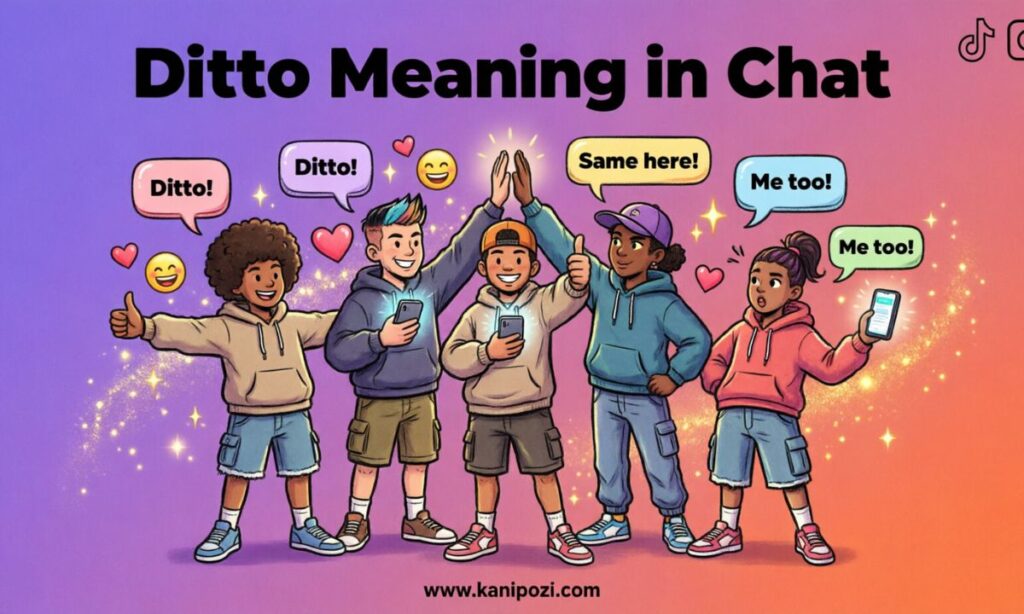
When someone sends you “ditto” in a text, DM, or group chat, they mean one of the following:
- “I feel exactly the same way” — the most common use
- “Same, honestly” — used in response to a relatable complaint or observation
- “Agreed” — a quick vote of support in a group decision
- “Back at you” — replying to a compliment or kind remark
It is shorter than typing “me too,” warmer than a thumbs-up emoji, and more conversational than “I concur.” That balance is why Gen Z gravitates toward it — especially in fast-moving group chats where speed matters and tone counts.
Ditto Meaning Love — The Romantic Context
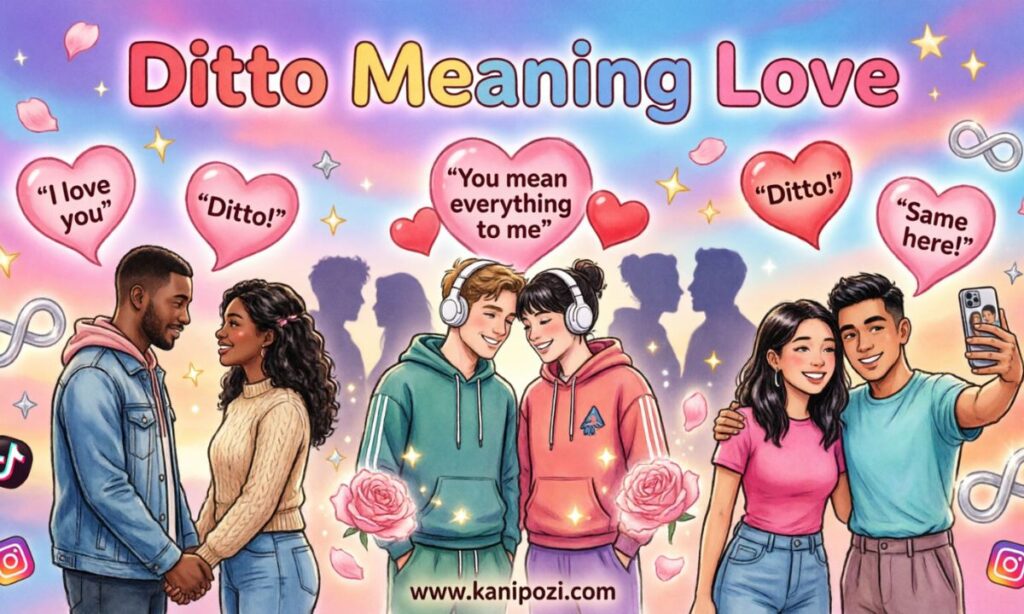
“Ditto” carries a well-known romantic meaning thanks in large part to the 1990 film Ghost. In that movie, Sam (Patrick Swayze) responds to Molly’s “I love you” with a quiet, heartfelt “ditto” — because he struggles to say the words directly. It became one of the most recognizable romantic exchanges in cinema history.
In that context, ditto as a love response means “I feel the same — I love you too” without saying the words outright. It implies a depth of feeling that is too big for standard language, yet real enough that one word covers it.
Today, using “ditto” romantically can mean:
- Returning affection without saying “I love you” first
- Echoing someone’s emotional vulnerability in a soft, understated way
- A playful callback to the Ghost reference between couples who share that cultural touchstone
It is tender, understated, and intentional — which is precisely what makes it resonate across generations.
Ditto Meaning Korean — The NewJeans Connection
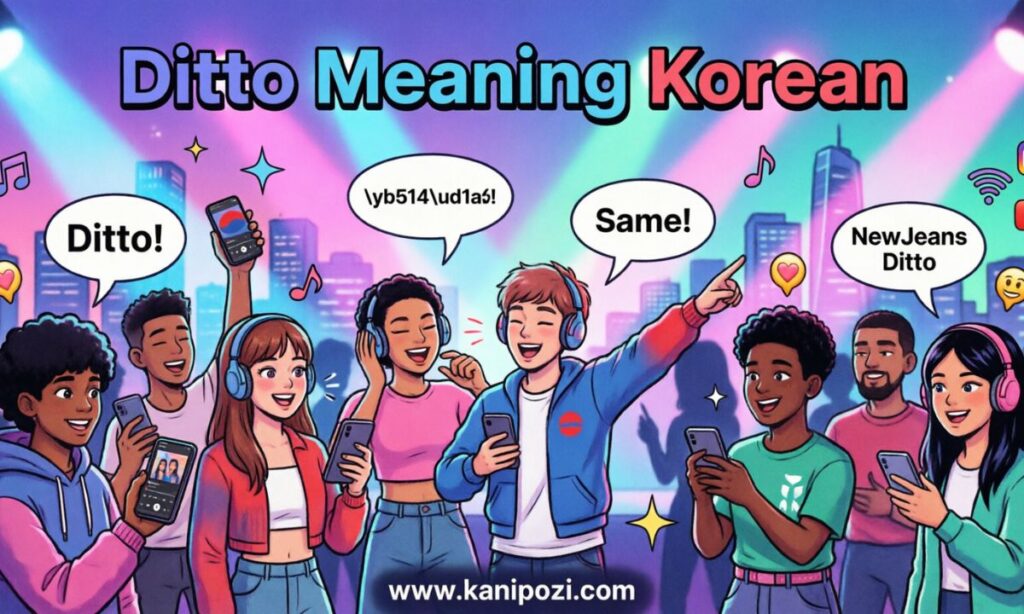
If you have spent any time in K-pop spaces since late 2022, you have encountered ditto in a completely different emotional context. South Korean girl group NewJeans released “Ditto” on December 19, 2022, and it became a massive global hit.
The song is about longing for reciprocation in love — wanting someone to say their feelings back. The chorus pleads “say it, say it back, oh, say it ditto,” meaning the singer wants to hear that the other person feels the same way.
The song topped charts in South Korea and entered the Billboard Hot 100, becoming NewJeans’ first entry on that chart. It won Song of the Year at the MAMA Awards, the Asia Artist Awards, and the Melon Music Awards in 2023.
In Korean fan culture and among K-pop listeners, “ditto” now carries an added layer of longing and emotional yearning — the desire to have your love echoed back to you. The word became culturally loaded in a way that blends English slang with K-pop romanticism, creating a crossover meaning that Gen Z global audiences immediately adopted.
Ditto Meaning in Construction
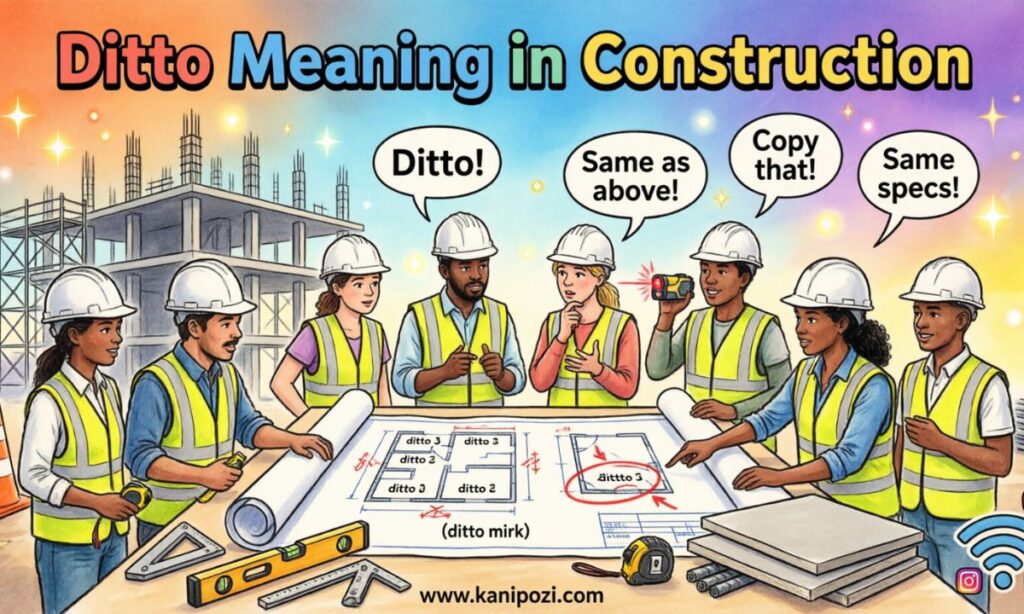
In professional and technical settings — particularly in construction and quantity surveying — ditto has an entirely different but equally specific meaning.
In construction documents, a ditto mark (“) or the word “ditto” is used to indicate that an item description in a list is the same as the one directly above it. This avoids repetition in detailed document tables, particularly in Bills of Quantities.
Ditto Meaning in BOQ (Bill of Quantities)
A Bill of Quantities (BOQ) is a formal document prepared by quantity surveyors that itemizes all the materials, labor, and services required for a construction project. It is used to standardize the tendering process so all contractors price the same scope of work.
In a BOQ, “ditto” appears in item description columns to signal: “This entry has the same description as the line above — refer back to avoid rewriting.”
Example in a BOQ table:
| Item | Description | Unit | Qty | Rate | Total |
| 1.01 | Excavation of foundation trench, depth 1.5m | m³ | 120 | — | — |
| 1.02 | Ditto, depth 2.0m | m³ | 85 | — | — |
Here, “ditto” in Item 1.02 means the work is the same type (excavation of a foundation trench) but with a different depth specification. It is a formal shorthand that saves time and reduces document length without losing precision.
This usage goes all the way back to the word’s original function in written English — repeating a previously stated description without rewriting it.
Origin + Evolution Timeline
Understanding where ditto comes from explains why it works so well across so many contexts.
1706 — First recorded English usage: The word “ditto” enters English from the Italian ditto (also spelled detto), which comes from the Latin dictum, meaning “something said.” It was originally a noun used in trade and merchant documents to avoid repeating item descriptions.
1700s–1800s — Formal written use: Ditto marks (“”) appear in lists, ledgers, and official documents across Europe and the English-speaking world. Construction and commercial documents adopt the convention widely.
1990 — Ghost and popular culture: The film Ghost launches ditto into romantic cultural consciousness. A generation grows up understanding “ditto” as a deeply felt, understated “I love you.”
2000s — Internet era begins: Online forums, chat rooms, and early social media see ditto used casually as “same” or “agreed” in comment sections and message boards.
2010–2020 — Meme culture and Tumblr: Ditto appears in relatable post chains and reblog culture. Its emotional nuance expands as younger users pick it up for solidarity-signaling in comment threads.
2020–2022 — TikTok and short-form video: TikTok duets and reply videos create a new format where “ditto” as a single-word response carries visual weight. The word migrates from text into video culture.
2022–2023 — NewJeans “Ditto”: The K-pop song gives the word a new romantic, yearning dimension and introduces it to a massive global Gen Z audience.
2024–2026 — Slang staple status: Ditto is now fully embedded across platforms — TikTok comments, Discord servers, Instagram replies, group texts, and gaming voice chats — without needing explanation.
How Gen Z Uses Ditto Today (2026 Focus)
Gen Z did not invent “ditto,” but they made it feel current again. Here is how it shows up across different digital spaces in 2026.
On TikTok: Ditto appears in comment sections under relatable POV videos, emotional storytimes, and trending audio clips. A video about burnout gets hundreds of “ditto” comments from viewers who feel the exact same way.
On Discord: In gaming servers and fan communities, ditto is quick, low-effort agreement that cuts through noise. Someone says the server is getting toxic, and three people reply “ditto” in seconds.
On Instagram: Under meme posts and caption-heavy reels, ditto works as a compact agreement signal — warmer than a like, shorter than a comment.
In Text Chats: Among close friends, ditto signals emotional solidarity. It validates the other person’s feeling without requiring elaboration, which is exactly what a 2 a.m. vent text sometimes needs.
In Gaming Voice Chat: Ditto is instant verbal acknowledgment — “need a break” / “ditto” — faster than any alternative.
Real Chat-Style Examples
Reading examples is the fastest way to understand how ditto actually flows in conversation:
Casual Agreement:
Person A: “This weather has been so draining.” Person B: “Ditto. I haven’t been outside in three days.”
Validation / Solidarity:
Person A: “I hate how fast summer goes.” Person B: “Ditto!! Every single year.”
Romantic / Affectionate:
Person A: “I really missed you today.” Person B: “Ditto 🥺”
Group Chat Vote:
Person A: “Can we push the plan to Saturday instead?” Person B: “Fine with me” Person C: “Ditto” Person D: “Same”
Playful / Humor:
Person A: “I could eat pizza every single day.” Person B: “Ditto and I would not feel one ounce of regret.”
Psychological + Social Meaning of Ditto
Language researchers studying digital communication have noted that short agreement signals like “ditto,” “same,” and “mood” perform a specific social function: they build group cohesion without requiring effort or vulnerability.
When someone says “ditto,” they are doing several things at once:
- Validating the speaker — confirming their feeling is real and shared
- Positioning themselves in the group — aligning with a sentiment or person
- Lowering conversational stakes — agreeing without escalating or competing
- Creating micro-connection — a brief but genuine moment of “me too”
In online spaces where people often feel isolated or misunderstood, a single “ditto” can feel surprisingly meaningful. Studies on digital language use have found that Gen Z specifically tends to prioritize emotional resonance in their communication choices — which is exactly what ditto delivers efficiently.
Similar Slang Comparison
How does “ditto” stack up against its alternatives?
| Slang Term | Vibe | Formality | Platform Best Fit |
| Ditto | Warm, genuine, slightly retro | Casual–Neutral | Universal |
| Same | Blunt, relatable | Very Casual | Texts, TikTok |
| Mood | Emotional, Gen Z | Very Casual | TikTok, Twitter/X |
| Facts | Emphatic agreement | Casual | TikTok, Discord |
| Agreed | Clean, slightly formal | Neutral–Formal | Discord, group chats |
| Me too | Direct, sincere | Casual | Texts, comments |
| I second that | Deliberate, group-signal | Slightly Formal | Discord, work chats |
| True that | Conversational, casual | Casual | Spoken, texts |
Ditto occupies a unique middle space — it is warmer than “same,” more interesting than “agreed,” and less trendy-specific than “mood.” That versatility is why it outlasts most slang cycles.
When NOT to Use This Slang
Ditto is a great word, but context matters. Avoid it in these situations:
Formal writing and professional emails. Using “ditto” in a work report or client-facing document reads as unprofessional unless you are using the technical construction/document meaning.
When someone shares serious news. If a friend tells you about a loss or serious struggle, “ditto” is not the response. It can feel dismissive in emotionally heavy moments that need more presence.
As a substitute for genuine engagement. If someone shares a creative project or asks for feedback, replying “ditto” to their excitement misses the moment. They need a real response.
When you mean something else. If your agreement is conditional or partial, “ditto” implies full alignment. Use it only when you genuinely mean “same — completely.”
Is “Ditto” Still Trending in 2026?
Yes — and that longevity is remarkable for a slang term. Most internet slang peaks fast and fades within 18 months. Ditto has maintained consistent usage because it is not tied to a single meme, trend, or platform moment.
Its staying power comes from a few factors. It is short and easy to type. It carries genuine emotional weight. It works in speech and in writing equally well. And its connection to the NewJeans song gave it a fresh wave of cultural energy in 2022–2023 that extended its shelf life significantly with Gen Z audiences globally.
In 2026, “ditto” appears across every major platform without sounding dated. It threads the needle between retro-cool and genuinely useful — which is rare for slang.
Pro Tips to Use Ditto Naturally
- Match the energy. If someone sends a long emotional message, “ditto” alone might feel cold. Pair it: “Ditto, honestly. I’ve been feeling the same all week.”
- Use it for positive things too. Ditto works for excitement and enthusiasm, not just complaints. “I can’t wait for the weekend.” / “Ditto!!”
- Add punctuation for tone. “Ditto.” reads as calm and grounded. “DITTO!!” reads as excited and emphatic. Small difference, big impact.
- Let it stand alone when context is clear. In a fast-moving chat where everyone already understands the topic, a solo “ditto” is perfect — no explanation needed.
Common Mistakes to Avoid
Using it sarcastically without signaling it. “Ditto” without clear context reads as sincere agreement. If you mean it ironically, add a tone marker or the person may miss it entirely.
Overusing it. Replying “ditto” to everything in a conversation flattens the word’s impact. Save it for moments when you genuinely mean it.
Confusing it with “ditto marks” in formal contexts. If you are preparing or reading a construction BOQ or official document, ditto is a technical term — not slang — and means the item description directly above is repeated.
Typing it when a full response is needed. Ditto is not a substitute for engagement. It signals shared feeling — it does not replace conversation.
Related Slang Words — Mini Glossary
| Term | Quick Meaning |
| Same | Immediate, casual agreement |
| Mood | This expresses exactly how I feel right now |
| Bet | Agreed / confirmed / understood |
| Facts | That is completely true / I strongly agree |
| Lowkey | Secretly, subtly, or to a moderate degree |
| No cap | Seriously, not joking |
| Understood the assignment | Someone did exactly what was needed |
| Vibe | An atmosphere, feeling, or aesthetic |
| Slay | Doing something excellently |
| I’m dead | That is so funny / I cannot believe that |
Frequently Asked Questions
What does ditto mean in slang?
Ditto means “same here” or “I agree” — it is a quick, casual way to echo someone else’s feeling or statement without repeating it word for word.
What does ditto mean in a text from a guy or girl?
It usually means they feel the same way you do. In a romantic context, it can be a soft, understated way of returning affection, especially as a reference to the famous Ghost film moment.
What does ditto mean in Korean?
In Korean pop culture, “ditto” gained its biggest recent meaning through the NewJeans song “Ditto” (2022), where it represents a longing for love to be said back — wanting someone to echo your feelings.
What does ditto mean in construction?
In construction and BOQ documents, “ditto” (or the ditto mark “) means the description or item from the line directly above is repeated — it is a documentation shorthand to avoid rewriting identical specifications.
Is ditto formal or informal?
Ditto is informal in casual conversation and online slang. However, in construction documents and formal written records, it is an accepted technical term used by quantity surveyors and engineers.
Can ditto be used as a compliment?
Yes. If someone says something kind and you reply “ditto,” you are returning the compliment. It works especially well as a warm, understated “same to you.”
Where did ditto originally come from?
Ditto comes from the Italian word detto (also ditto), derived from the Latin dicere, meaning “to say.” It entered English in the early 1700s as a way to reference something already stated.
Conclusion
“Ditto” is one of those words that sounds simple but runs surprisingly deep. It is casual slang, romantic shorthand, K-pop cultural reference, and professional construction terminology all at once. That kind of range does not happen by accident — it happens because the word has been genuinely useful across centuries, contexts, and cultures.
For Gen Z in 2026, ditto remains a go-to for quick, warm agreement online. Whether you drop it in a TikTok comment, a late-night group chat, or a heartfelt reply to someone you care about, it lands cleanly and authentically every time — as long as you read the room first.
Now you know exactly what it means, where it comes from, and how to use it without missing the mark. Ditto.

Sam Witty is an experienced content writer with 7 years of expertise in language, word meanings, and linguistic research. His mission at Kanipozi is to provide accurate, easy-to-read definitions that make learning new words simple, fast, and enjoyable