You see it everywhere. A friend posts something questionable online. A coworker sends a baffling email. Someone cuts you off in traffic and you have zero words left. Enter: SMH. It stands for “Shaking My Head” and it captures a very specific feeling that other words struggle to describe — that perfect mix of disappointment, disbelief, and quiet resignation. If you have ever typed it without really knowing why it works so well, this article explains everything.
What Does SMH Actually Mean?
SMH stands for “Shaking My Head.” It is used to express disappointment, disbelief, embarrassment, or disapproval, usually in response to something foolish, frustrating, or just plain baffling. Think of it as the digital equivalent of looking at someone and slowly shaking your head without saying a single word.
Unlike a lot of internet slang that takes three paragraphs to decode, SMH is beautifully efficient. The gesture itself is universal. You do not need a language in common with someone to understand what a slow head shake means. SMH just translates that into text.
Where Did SMH Come From?
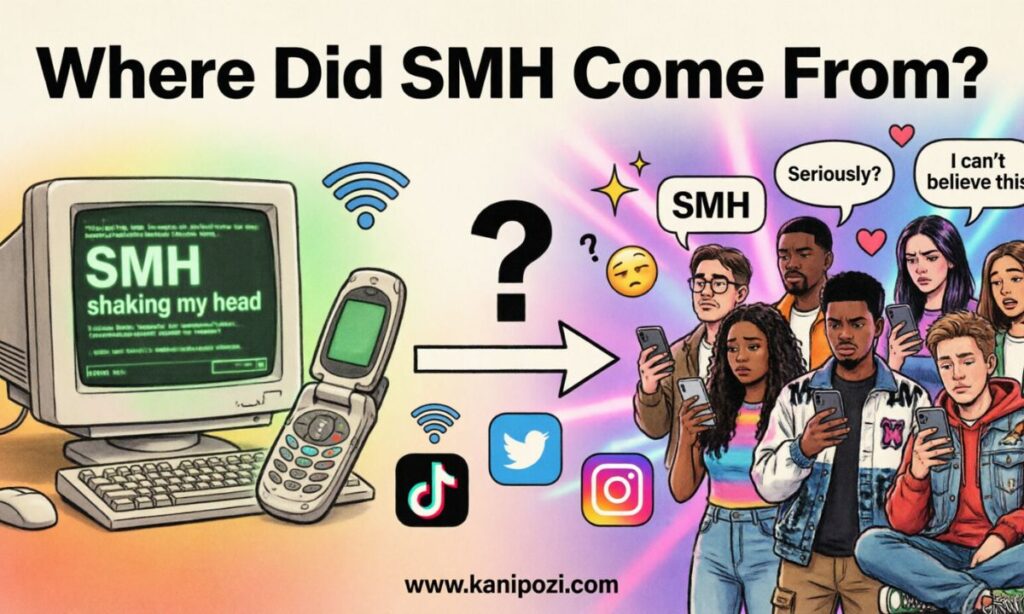
SMH grew out of the early internet era, where people needed fast ways to express emotions in chat rooms, text messages, and online forums. The phrase “shaking my head” predates the internet by centuries, used in everyday speech and literature to signal quiet disapproval or disbelief.
As a text abbreviation, SMH started appearing in online spaces around the early 2000s, gaining serious traction on platforms like Twitter, Tumblr, and later Instagram. By the 2010s, it had crossed into mainstream usage across age groups and cultures.
The act of shaking one’s head in sorrow or disbelief even appears in ancient texts, including the Bible. In Lamentations 2:15 and Job 16:4, people shake their heads at suffering and wrongdoing, a deeply human response that has never gone out of style. SMH just gave that gesture a keyboard shortcut.
The Spectrum of SMH: What Tone Does It Carry?
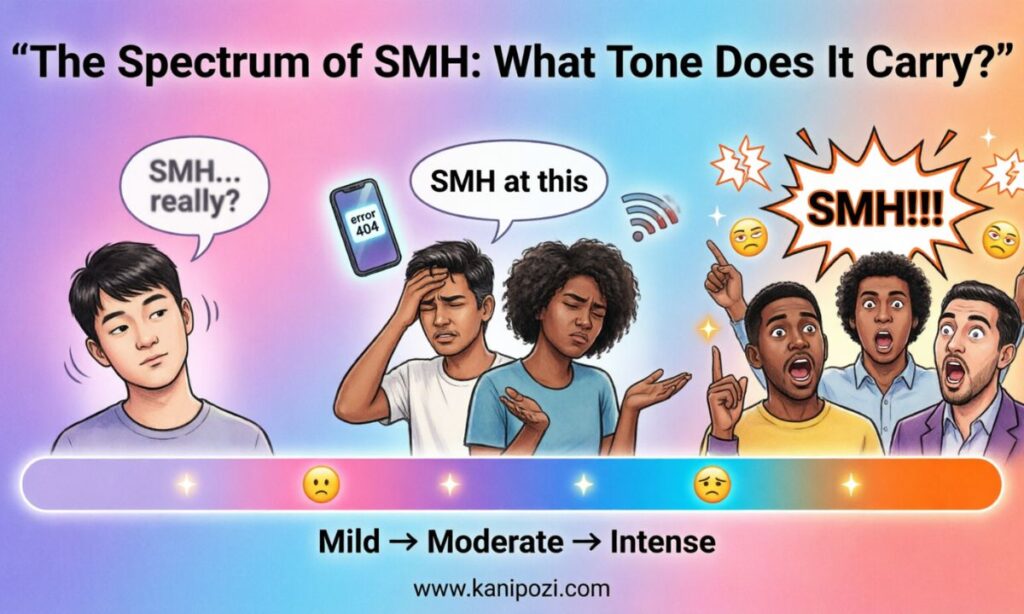
Here is what makes SMH genuinely useful rather than just another acronym. It covers a surprisingly wide emotional range, and the tone shifts depending on context.
Disappointment: “He forgot our anniversary again. SMH.” Disbelief: “They actually tried to microwave the laptop. SMH.” Light humor: “My dog ate my charger. SMH, again.” Gentle teasing: “You still think pineapple belongs on pizza? SMH.” Exasperation: “Three hours in traffic for a two-mile drive. SMH.”
One acronym. Five completely different emotional flavors. Context does the heavy lifting.
Real-Life Conversation Examples
Seeing SMH in action makes its meaning click instantly. Here are a few everyday scenarios.
Example 1 Person A: “I just spent 20 minutes looking for my glasses and they were on my face.” Person B: “SMH. You need help.”
Example 2 Person A: “My boss scheduled a 6pm meeting on a Friday. Again.” Person B: “SMH. Some people just love chaos.”
Example 3 Person A: “He said he was stuck in traffic but I saw his location at a restaurant.” Person B: “SMH. At least pick a better lie.”
SMH vs Similar Slang: A Quick Comparison
SMH shares territory with a few other popular expressions. Knowing the difference helps you pick the right one every time.
| Slang | Stands For | Best Used For | Intensity |
| SMH | Shaking My Head | Disappointment, disbelief, mild exasperation | Low to medium |
| SMDH | Shaking My Damn Head | Stronger frustration or disbelief | Medium to high |
| FFS | For goodness sake | Impatience, frustration | High |
| Facepalm | The gesture itself | Embarrassment, someone else’s blunder | Low to medium |
If SMH is a sigh, SMDH is a groan. Choose accordingly.
If MOG seems confusing, read MOG Meaning Slang for full details.
Which One Should You Use?
This comes down to two things: the situation and who you are talking to.
Use SMH when the moment calls for quiet, knowing disappointment. It is casual, not aggressive. Use SMDH when the situation genuinely earns a stronger reaction, and reserve it so it keeps its impact. Avoid SMH in professional settings like work emails or client messages, even casual ones. It can easily read as dismissive. And if you are texting someone older or someone unfamiliar with internet slang, just write out “shaking my head” for clarity.
Common Mistakes People Make With SMH
SMH is simple, but a few misuses creep in regularly.
Using it for positive moments is the biggest one. SMH signals something wrong or baffling. Typing “I got a promotion! SMH!” sends a confusing message. Save it for the facepalm moments.
Misreading it as “scratching my head” is also common, especially among people new to the term. The two feel similar in meaning but SMH always means shaking, not scratching.
Overusing it drains the expression of any impact. When everything gets an SMH, nothing does.
Dropping it into formal communication is a quick way to look unprofessional. A work email is not the place for it, no matter how maddening the situation was.
Does SMH Have Any Variations?
Yes, and they each carry a slightly different flavor.
SMDH adds “damn” for emphasis when a regular SMH just does not cut it. SMH MHM is a sarcastic combo that basically means “yep, exactly what I expected.” Some people also use smfh, which adds stronger language for moments of serious frustration. And occasionally you will see SMH at myself, where someone turns the disappointment inward, usually after doing something they knew better than to do.
Is SMH Ever Positive?
Mostly no, but occasionally it gets used in a playful or affectionate way between close friends. “You brought me food without asking? SMH, you are too good.” Here the disbelief is warm rather than critical. This works only when the relationship and tone make it obvious. In most other cases, SMH leans negative, so be careful with creative interpretations around people who might take it the wrong way.
When Did SMH Go Mainstream?
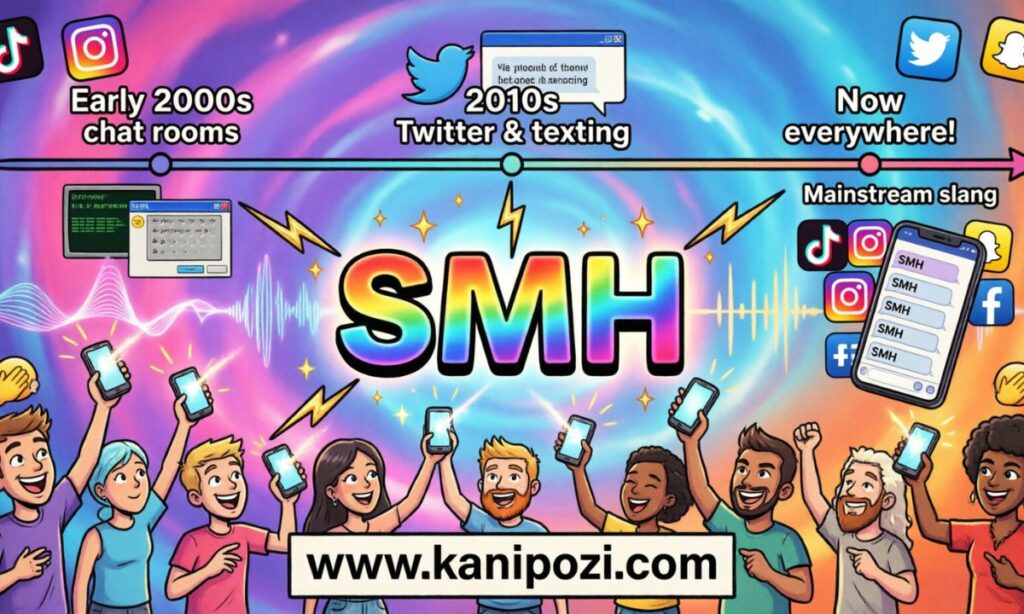
While SMH was circulating in niche online communities through the 2000s, it really exploded into mainstream culture between 2010 and 2014. Meme culture, Black Twitter, and the rise of short-form social media gave it the perfect environment to spread fast. It appeared in news headlines, celebrity tweets, and eventually in everyday text conversations between people who had never heard of a chat room. By the mid-2010s, SMH had officially crossed the line from internet slang to everyday language.
Frequently Asked Questions About SMH
Does SMH always mean disappointment?
Not always. While disappointment is the most common tone, SMH can also express disbelief, mild amusement, or playful teasing depending on the context and relationship. The surrounding message usually makes the intention clear.
Is it okay to use SMH at work?
In most professional settings, no. Even in casual workplaces, SMH can come across as dismissive or sarcastic. If you genuinely feel frustrated, expressing it in full words keeps communication clearer and more respectful.
What is the difference between SMH and SMDH?
SMH is the standard, relatively mild version. SMDH adds “damn” for extra emphasis. Use SMDH when the situation is more absurd or frustrating than your average SMH moment deserves.
Conclusion
SMH is one of those rare pieces of internet slang that actually earns its place. It is fast, expressive, and universally understood. Three letters that carry the weight of a whole slow head shake. Whether you are reacting to a baffling news story, a friend’s questionable decision, or your own Monday morning mistake, SMH does the job with zero wasted words.
Just remember: use it where the tone fits, skip it in professional conversations, and never overdo it. The head shake only works when it means something.