If you’ve been scrolling through TikTok, Discord, or Instagram lately, you’ve probably seen the word mog popping up everywhere. Someone posts a gym photo and gets a comment: “You just mogged everyone in that locker room.” A skater lands a trick and the replies flood in: “Absolute mog.” Even Olympic gold medalist Alysa Liu made headlines in early 2026 when she said her goal was to mog the competition — and she delivered.
So what exactly does mog meaning slang cover? Where did it start? And why can’t Gen Z seem to stop using it? This article breaks it all down — from the core definition and origin to real-life usage, alternate meanings, and the psychology driving this trend.
⚡ ULTRA FEATURED SNIPPET: What Does MOG Mean?
MOG (also: mogging, mogged) is a Gen Z and Gen Alpha internet slang term meaning to dominate, outshine, or outperform someone — especially in appearance, skill, or presence. If you “mog” someone, you are visibly, undeniably better than them in that moment. If you get “mogged,” someone else just overshadowed you.
Quick-reference summary:
| Term | Meaning |
|---|---|
| Mog | To outclass or outshine someone |
| Mogging | The act of dominating over someone |
| Mogged | Having been outclassed by another person |
| Mogger | The person doing the mogging |
| Moggee | The person who got mogged |
Core Mog Meaning Explained
At its simplest, mog meaning in slang refers to surpassing someone so completely that they almost disappear by comparison. It’s a compliment aimed at the winner and a playful jab at everyone else in the room.
Think of it this way: if you walk into a party in a jaw-dropping outfit and every head turns, you just mogged the room. If your friend posts a gym selfie next to a professional bodybuilder and looks tiny by comparison, your friend just got mogged.
The mog meaning is almost always used in a lighthearted, humorous, or admiring tone. It’s not a cruel insult — it’s competitive banter with a side of genuine respect. When Gen Z calls someone a mog, they’re essentially saying: “This person is operating on a completely different level.”
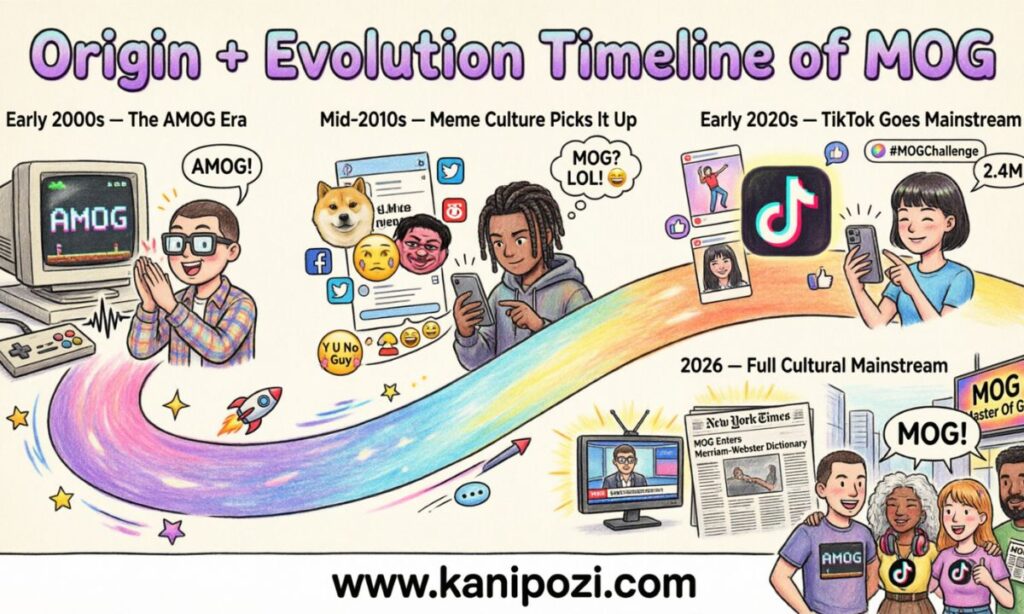
Origin + Evolution Timeline of MOG
Understanding where mog meaning came from makes the word click much faster. Here’s the full timeline:
Early 2000s — The AMOG Era The word mog traces back to AMOG, an acronym for Alpha Male of the Group. This term originated in early internet forums — particularly in fitness and dating communities — where users debated social dominance, physical attractiveness, and hierarchy. The concept was rooted in the pseudoscientific “manosphere” idea that every male group has a dominant figure.
Mid-2010s — Meme Culture Picks It Up As meme culture exploded, AMOG shortened to mog. Online communities started using it to compare physiques, jawlines, and hairstyles in a competitive but jokey way. Subcultures around looksmaxxing (optimizing your appearance) adopted mogging as an everyday verb.
Early 2020s — TikTok Goes Mainstream TikTok blew the mog meaning wide open. Creators used it in reaction videos, duets, and gym content. The word escaped its original niche and started appearing in gaming livestreams, fashion posts, and meme compilations. By 2022–2023, mogging had transcended appearance and expanded to cover skill, style, confidence, and wit.
2026 — Full Cultural Mainstream Today, mog meaning is recognized even by major dictionaries. Merriam-Webster now officially tracks “mog” as slang. Olympic athletes use it in press conferences. Brands reference it in campaigns. It’s a full-blown cultural moment — and it shows no signs of fading.
How Gen Z Uses MOG Today
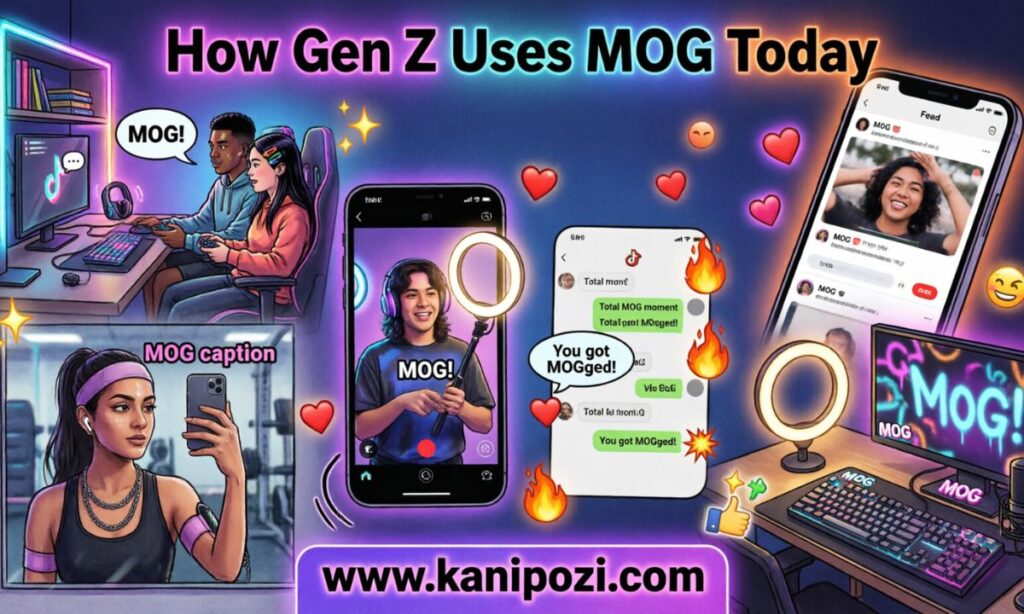
The mog meaning in 2026 is far more flexible than its origins suggest. Gen Z applies it across three broad categories:
1. Appearance and Physical Presence This is the original use — comparing looks, physique, fashion, or overall visual impact. Someone who walks into a room and immediately commands attention is mogging everyone there.
2. Skill and Performance Gamers, athletes, and students use mog to describe dominating a task so completely that others look outmatched. Finishing a coding project in half the time your team expected? You just mogged the deadline.
3. Wit, Humor, and Social Intelligence In text-based conversations and Discord servers, mog has evolved to cover social wins too — landing the perfect comeback, dropping a meme that breaks the group chat, or making an argument so cleanly that no one can respond.
Real Chat Style Examples
Here’s how mog meaning actually looks in real conversations:
Example 1 — Gym Chat
Alex: Bro, did you see Marcus at the gym today? Jordan: Yeah, he literally mogged everyone there. The man just exists differently.
Example 2 — Gaming Discord
Kai: She just 1v4’d the whole team Priya: Absolute mog. I would’ve alt-F4’d out of shame.
Example 3 — Fashion TikTok Comment
“She walked onto that runway and mogged every other model. Not even close.”
Example 4 — Group Chat
Sam: I finished the 10-page essay in 2 hours Riley: Sam mogging us all again, as per usual
Example 5 — Casual Banter
“Just got mogged by a golden retriever at the park. His coat was immaculate.”
Notice how mog meaning shifts tone across contexts — it can be sincere admiration, playful trash talk, or self-deprecating humor. That flexibility is exactly why Gen Z loves it.
MOG Meaning in Specific Contexts
MOG Meaning: Wedding

In wedding planning circles, MOG is a completely separate term with zero connection to internet slang. MOG stands for Mother of the Groom — a formal role with specific duties. The MOG typically helps plan the rehearsal dinner, assists with the guest list, coordinates her outfit with the Mother of the Bride (MOB), and offers emotional support throughout the wedding process. If you see MOG on a wedding website, it has nothing to do with dominating anyone.
MOG Meaning: Cat
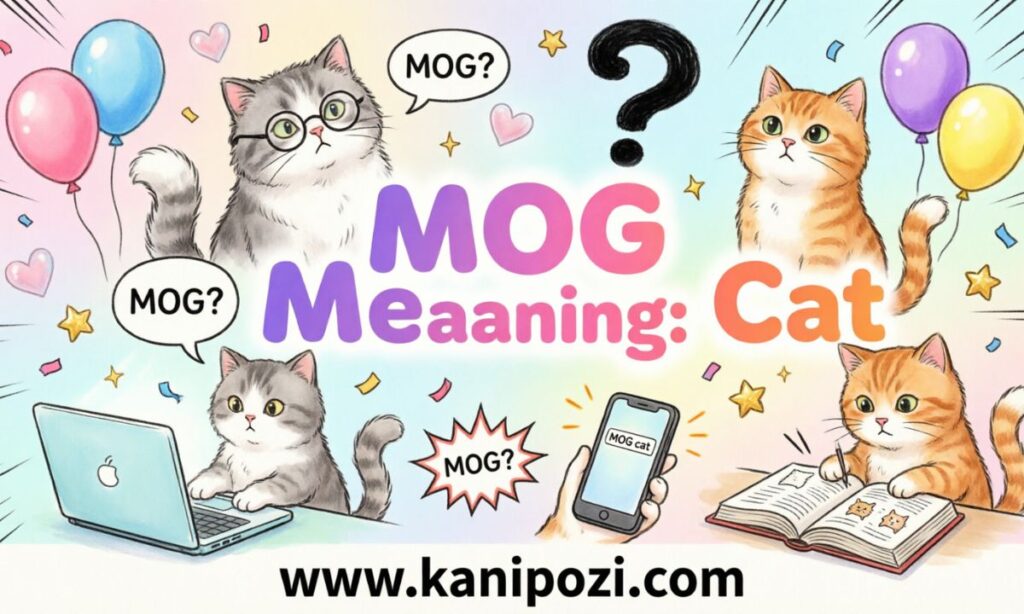
“Mog” is also British slang for a domestic cat, especially an ordinary mixed-breed cat. The term has been used in the UK for decades. It comes from “moggy” or “moggie,” a friendly, informal word for a cat. Completely unrelated to the Gen Z slang version — unless your moggy happens to be more photogenic than you, in which case you genuinely got mogged.
MOG Meaning: Medical
In a medical context, MOG stands for Myelin Oligodendrocyte Glycoprotein — a protein found on the surface of myelin-producing cells in the brain. MOG-antibody disease (MOGAD) is a rare autoimmune condition affecting the central nervous system. This has no connection to internet slang whatsoever.
MOG Meaning in Business
In some business and organizational contexts, MOG can stand for Manager of Operations Group or appear as an internal team abbreviation. It’s also occasionally used as a ticker or abbreviation in finance and crypto communities — notably, there is a meme cryptocurrency called MOG Coin. In a professional email, assume the business definition; in a text from your Gen Z colleague after the big pitch, assume they mean you dominated the room.
Similar Slang Comparison: MOG vs. Other Terms
| Slang | What It Means | How It Differs from MOG |
|---|---|---|
| GOAT | Greatest of all time | Permanent, career-based status; mog is moment-specific |
| Chad | Confident, alpha-type male | Personality archetype; mog is an action |
| Slay | Doing something exceptionally well | More fashion/performance-focused; mog implies direct comparison |
| Flex | Showing off an achievement | Self-directed boasting; mog is about outshining others |
| Boss | Someone commanding and capable | Authority-based; mog is peer-to-peer |
| NPC | Someone acting robotic or unimpressive | Opposite of a mogger — the person who gets mogged |
The key difference: mog meaning always involves a comparison. You don’t mog in a vacuum — you mog someone or a group. That relational element sets it apart from most other Gen Z slang.
Psychological + Social Meaning of MOG
Why has mog meaning caught on so powerfully? Psychology has a few answers.
Social comparison is hardwired into us. Humans constantly assess where they stand relative to others — in status, attractiveness, and competence. Mog gives that instinct a fun, low-stakes vocabulary. Instead of expressing envy or insecurity directly, Gen Z says “I just got mogged” and laughs it off.
It creates community through humor. Calling someone a mogger is often a sign of respect wrapped in comedy. It’s how young people express admiration without sounding uncool or overly sincere. The playful framing keeps egos intact on both sides.
It signals cultural fluency. Using mog correctly — knowing when it applies, how to deploy it for maximum comedic effect — shows you’re plugged into the current internet moment. For Gen Z, that kind of linguistic awareness is a subtle form of social currency.
As Psychology Today noted in early 2026, a lot of mogging is essentially trash talk on a basketball court — competitive, bonding, and mostly harmless when kept in the right context.
When NOT To Use MOG Slang
Knowing the mog meaning is half the battle. Knowing when to hold back is the other half.
Avoid it in professional settings. Your quarterly review is not the time to tell your manager you “mogged the whole sales team.” Stick to conventional language in emails, meetings, and presentations.
Be careful with body-image comparisons. Mog meaning has roots in looksmaxxing culture, which can veer into toxic territory. Using it to rank people’s physical appearance seriously — rather than humorously — can cause real harm, especially to younger teens already battling insecurity.
Don’t use it with people who aren’t familiar with the slang. Telling a 55-year-old coworker they “totally mogged the presentation” will likely just confuse them. Read the room.
Avoid escalating mog wars. When mogging becomes an obsessive, ongoing competition over appearances, it stops being fun banter and starts reinforcing unhealthy comparison loops. Use it lightly.
Is MOG Slang Still Trending in 2026?
Yes — and then some. The mog meaning reached a genuine cultural milestone in early 2026 when Olympic figure skater Alysa Liu used the word in a nationally broadcast press conference, saying her goal was to “mog” the competition. The clip went massively viral.
Merriam-Webster officially added mog to its slang dictionary, cementing its place in the language. Educators, parents, and journalists began writing explainers. Even mainstream brands started testing the word in their social media copy.
Mog is no longer just a niche internet word. It’s entered the broader cultural vocabulary — which, paradoxically, sometimes signals a slang term is about to peak and slow down. But for now, mog is still very much alive, very much used, and very much a staple of Gen Z online communication in 2026.
Pro Tips to Use MOG Naturally
If you want to use mog meaning in a way that sounds genuinely fluent:
- Lead with the verb form. “She mogged everyone” flows more naturally than “She is a mog.”
- Use it for unexpected moments. The funniest and most resonant mog references involve surprising comparisons — your dog mogging you, a grandma mogging a fitness influencer.
- Pair it with understatement. “He just quietly mogged the entire squad” lands harder than yelling it.
- Self-deprecating mogging is peak Gen Z. Saying “I just got mogged by a houseplant” is funnier and more relatable than talking about mogging others.
- Know your audience. Mog works great in casual chats, comment sections, and group messages. It doesn’t work in formal writing.
Common Mistakes When Using MOG
Even people who know the mog meaning slip up. Here’s what to avoid:
Mistake 1: Using it as a pure insult. Mog is meant to be playful admiration or light banter, not a genuine put-down. Weaponizing it makes you the problem, not the mogger.
Mistake 2: Confusing the contexts. If your cousin texts that the MOG looked stunning at the wedding, they probably mean the Mother of the Groom, not that someone outclassed everyone there (though both could theoretically be true).
Mistake 3: Overusing it. Dropping mog into every sentence signals you just learned it and you’re trying too hard. Use it sparingly for maximum effect.
Mistake 4: Getting the grammar wrong. Mog works as a transitive verb (“She mogged him”), an intransitive verb (“She just absolutely mogs”), and a noun (“He’s a certified mogger”). Saying “She is mog” sounds off.
Related Slang Words: Mini Glossary
| Slang Term | Meaning |
|---|---|
| Looksmaxxing | Optimizing your physical appearance through habits or procedures |
| Jawmogging | Specifically being mogged by someone with a stronger jawline |
| Hairmogging | Being outclassed by someone with superior hair |
| NPC | Someone perceived as background, unimpressive, or generic |
| Rizz | Natural charisma or the ability to attract others effortlessly |
| Slay | Performing exceptionally well in appearance or a task |
| W | A win; used similarly to mog in celebrating victory |
| Ratio | Getting more replies than likes — a social media version of being mogged |
| No cap | Truthfully; used to confirm a mog claim is genuine |
| Main character energy | Acting like the protagonist of a story; closely related to mog energy |
Frequently Asked Questions About MOG Meaning
What does MOG mean in slang?
MOG means to outshine, dominate, or outperform someone — usually in looks, skill, or presence. It’s used admiringly or playfully.
Where did the word MOG come from?
It came from AMOG — Alpha Male of the Group — a term from early 2000s internet forums that later shortened and spread through meme culture and TikTok.
What does “getting mogged” mean?
Getting mogged means being visibly outclassed by someone else in a particular context — like standing next to someone much more stylish or skilled than you.
Is MOG a positive or negative word?
Mostly positive. Calling someone a mogger is a compliment. Saying you got mogged is usually self-deprecating humor, not a serious insult.
What does MOG mean in a wedding context?
In weddings, MOG stands for Mother of the Groom — a completely separate meaning unrelated to internet slang.
What does MOG mean medically?
In medicine, MOG stands for Myelin Oligodendrocyte Glycoprotein, related to a rare autoimmune neurological condition called MOGAD.
Is MOG still used in 2026?
Yes. Mog is actively used across TikTok, Discord, gaming communities, and casual conversation in 2026, with growing mainstream recognition.
Can girls use the word MOG?
Absolutely. While mog originated in male-dominated online spaces, it’s now used by all genders to describe anyone who outshines others in any context.
What’s the difference between mogging and flexing?
Flexing is self-promotion — showing off your own wins. Mogging is about comparison — being so good that others look lesser by contrast.
What does “mog face” mean?
Mog face refers to the expression someone makes when they realize they’ve just been outclassed — a mix of awe, defeat, and reluctant admiration.
Conclusion
The mog meaning in 2026 is a study in how internet slang evolves — starting in niche forums, exploding on TikTok, getting picked up by athletes and celebrities, and eventually landing in actual dictionaries. What began as a bodybuilding and looks-ranking term is now a flexible, cross-platform expression of admiration, competitive humor, and social fluency.
Whether you’re using it to hype a friend’s outfit, describe a gaming triumph, or playfully admit defeat, mog fits the moment because it captures something real: that feeling when someone else is just operating differently, and you can’t help but respect it.
Now that you fully understand mog meaning — go out there and mog responsibly.